
tube expander vs. Pipe Fixation: What's the Difference? When Is Each Process Step Appropriate?
fixing expanding are both methods used to expand in the bore of the tube end. Both methods are used in the manufacture of -to-tube-end joints—but they serve different purposes and are generally not interchangeable. Anyone who confuses the two methods risks welding defects such as porosity and -to-tube-end joints that do not meet the requirements. tubes tube tube
This post provides a direct comparison of the technical differences.
What is " fixing"?
fixing ing a pipe is an essential part of the welding preparation. During fixing , the tube is expanded in a ring shape precisely at the position to be welded, thereby positioning it centrally and gap-free within the bore. This step is always performed before welding and applies exclusively to the subsequent welding position—not to the entire tube pipe-to-head contact area. Centric positioning is an absolute prerequisite for achieving reproducible welds without porosity or fusion defects during orbital welding.
What is " expanding"?
Tube rolling is an essential step in the manufacture of tube-to-tube-head joints. During the “ expanding ” process, the “ tube ” is expanded across a defined rolling width—significantly more than just at a single point. “ expanding ” is typically performed after welding. The purpose: The gap between “ tube ” and the tube head is closed across the entire rolling width to prevent corrosion at the weld and create a force-fit connection.
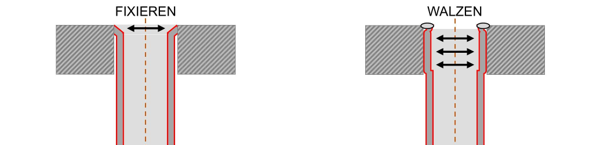
Source: TECHNODATA Catalog 2025, p. 5
fixing expanding : A Head-to-Head Comparison
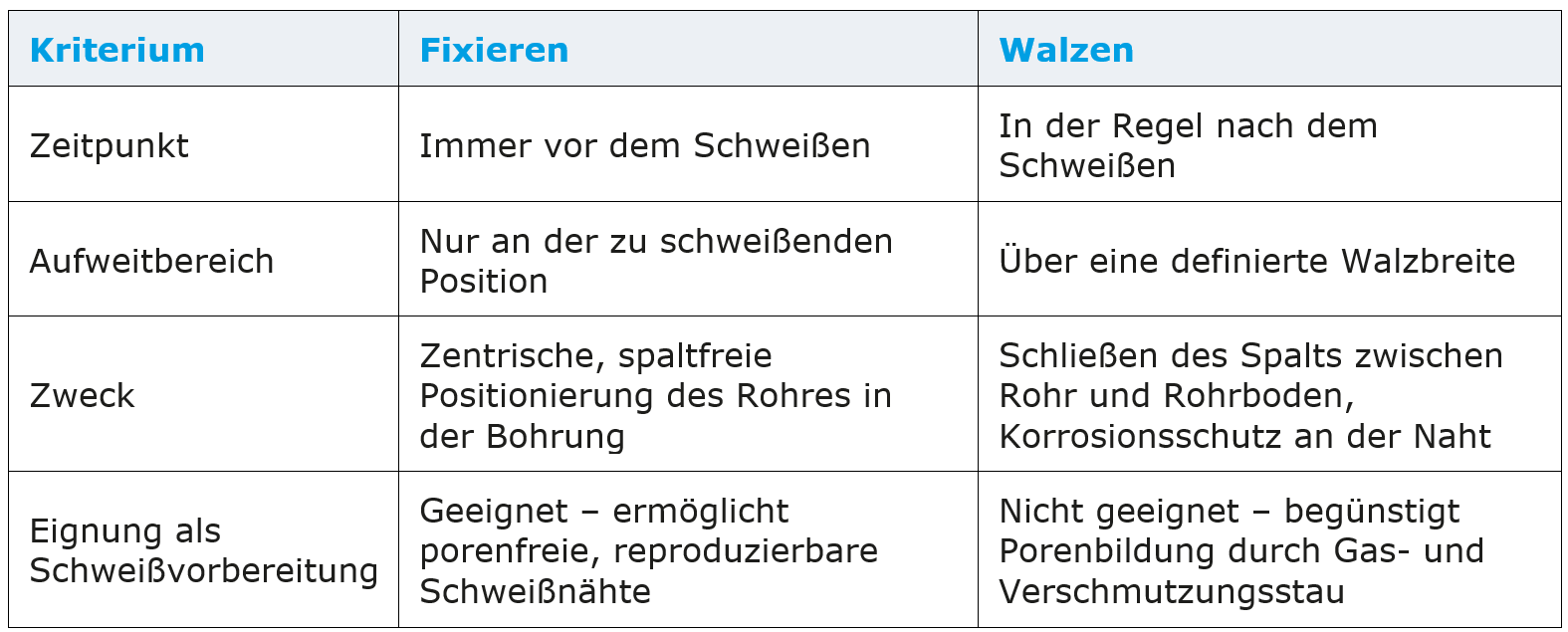
Why " expanding " is generally not a suitable alternative to " welding preparation "
The key difference lies in the expansion zone: In the “ expanding ” process, the gap between the “ tube ” and the bore is closed along the entire rolling width. As a result, neither welding gas nor any contaminants can escape along the length of the pipe. They are forced ahead of the arc until they accumulate in the final section of the 360° welding cycle—contaminating the weld and resulting in porosity.
This effect does not occur with fixed tubes : The ring-shaped fixing melts during the welding process, allowing gas and impurities to flow backward throughout the entire welding cycle. fixing is thus specifically designed to meet the requirements of the welding process— expanding , to ensure a permanent, mechanically locked joint afterward.
Two exceptions prove the rule. For fillet welds without a bevel, the gas flow remains unobstructed even after the expanding —in this case, a expanding of the tubes is possible even before welding. With highly reactive refractory metals such as titanium, however, the opposite is true: Above approximately 400 °C, these materials react extremely vigorously with atmospheric gases such as oxygen and nitrogen and immediately become brittle. Therefore, complete gas coverage of the weld area is crucial when welding titanium. The zero gap in the tube head created by roll sealing reliably prevents atmospheric oxygen from being drawn into the molten pool from the unprotected rear side. Subsequent “ expanding ” after welding would immediately destroy the brittle heat-affected zone—therefore, for titanium, roll sealing before welding is not only permissible but recommended.
Conclusion
fixing expanding are not mutually exclusive but complement each other in the -to-tube-sheet connection—just at different times and with different objectives. For the , there is no technical alternative to the . The tube welding preparation fixing tube fixing machine TES 97 performs this step in one to two seconds. For the subsequent step of closing the gap, expandingtube expander , available in various designs and driven by electric or pneumatic tube-rolling technology, are available.